

Native & adapted
Texas sage
Leucophyllum frutescensAlso known as Texas ranger · Barometer bush · Cenizo
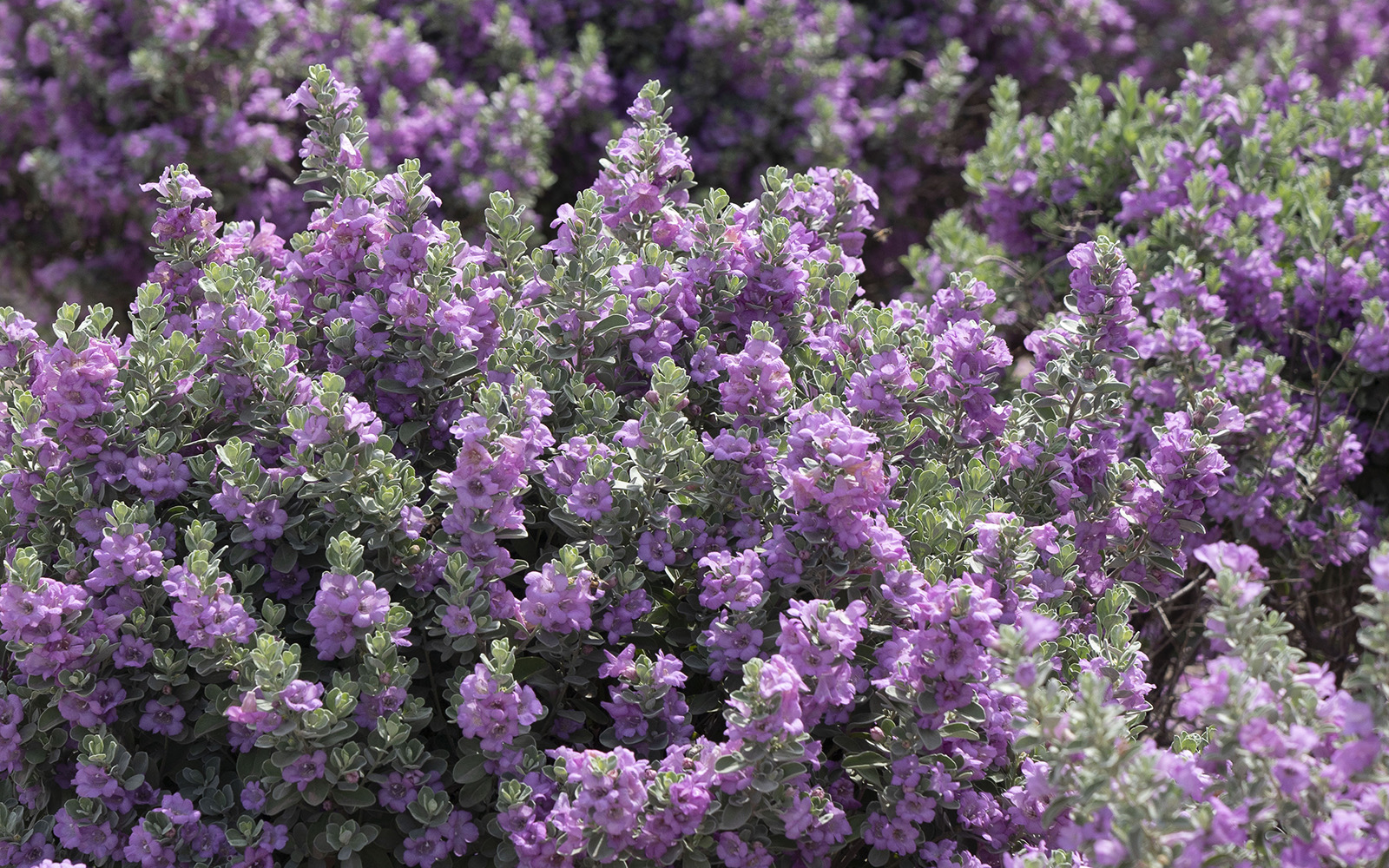
Silver-leaved Chihuahuan Desert shrub whose pink, purple, or white flowers respond dramatically to monsoon humidity and rain.
Right plant, right place
Will Texas sage grow at your Arizona property?
Excellent as an informal hedge or rounded screen. Choose a cultivar by mature size and flower color instead of repeatedly shearing an oversized selection.
Best regional fit: Urban core · USDA 9b–10a, Valley suburbs · USDA 9a–9b, Desert outskirts · USDA 8b–9b.
Light
Sun exposure
Full or reflected sun for dense growth and the strongest flower display.
Water
Irrigation
Very low once established. Let the soil dry between deep irrigations and avoid chronically wet roots.
Harvest
How to use it
Not edible; summer-to-fall blooms support pollinating insects.
Choose the actual plant, not only the label
Cultivars & selections
Texas sage cultivars vary from compact 3-ft shrubs to 8-ft screens. Choose by mature size and foliage/flower color so the plant can keep its natural form without power shearing.
Green Cloud
Leucophyllum frutescens ‘Green Cloud’Mature size6–8 ft tall × 6–8 ft wide
Best forLarge informal hedges and strong purple bloom
Greener foliage and deep magenta-purple flowers on a vigorous screen-sized shrub.
Compacta
Leucophyllum frutescens ‘Compacta’Mature size3–5 ft tall × 3–5 ft wide
Best forSmaller beds and low hedges
Compact gray-green form that fits residential planting strips better than full-sized selections.
Heavenly Cloud
Leucophyllum frutescens ‘Heavenly Cloud’Mature size6–8 ft tall × 6–8 ft wide
Best forLarge rounded form and prolific lavender bloom
A substantial shrub; reserve enough width to keep it natural rather than boxed.
Silverado
Leucophyllum frutescens ‘Silverado’Mature size5–6 ft tall × 5–6 ft wide
Best forBright silver foliage and medium-size screens
Dense silver leaves give strong contrast even between flowering flushes.
White Cloud
Leucophyllum frutescens ‘White Cloud’Mature size5–7 ft tall × 5–7 ft wide
Best forWhite flowers and pale foliage
A useful light-colored alternative to the usual pink and purple flowering forms.
Planting & stewardship
How to help Texas sage thrive
- 1
Match the cultivar’s mature size to the available space before planting.
- 2
Plant in fast-draining soil and avoid placing it in frequently irrigated lawn conditions.
- 3
Prune selectively to retain the natural rounded form rather than clipping it into a box.
- 4
Expect flowering flushes around monsoon humidity and summer rain.